Thursday, September 9, 2010

EARTHQUAKE!


Dreams from the LORD 2007-2010
7 September 2010

Last night I had a dream where I was in Buffalo, Wyoming. I was walking on the side of this mountain when the earth began to shake; the ground gave way underneath me. I then walked some more up the mountain and the earth shook again and the earth gave way underneath me. I began to walk a third time up the mountain and the earth shook again and the earth gave way underneath me. The earth shook three times in a span of maybe sixty seconds.

I believe the earth shaking three times in sixty seconds means something. Could it mean three days? Three weeks? I am not sure.

Wednesday, September 8, 2010

Consecrated to the Will of God - Watchman Nee


The Normal Christian Life
By Watchman Nee

Chapter 6: “The Path of Progress: Presenting Ourselves to God”

Page 102: “On one occasion a Chinese brother was traveling by train and found himself in a carriage together with three non-Christians who, in order to beguile the time, wished to play cards. Lacking a fourth to complete the game, they invited this brother to join them. ‘I am sorry to disappoint you,’ he said, ‘but I cannot join your game for I have not brought my hands with me.’ ‘Whatever do you mean?’ they asked in blank astonishment. ‘This pair of hands does not belong to me,’ he said, and then there followed the explanation of the transfer of ownership that had taken place in his life. That brother regarded the members of his body as belonging entirely to the Lord. That is true holiness.

“Paul says, ‘Present your members as servants to righteousness unto sanctification [A.V. ‘holiness to the Lord’ (Exod. 28:36)]. I gave myself over wholly to Christ: that is holiness.”

Page 103: “Then to what are we to be consecrated? Not to Christian work, but to the will of God, to be and to do whatever he requires.”

Tuesday, September 7, 2010

A Pie in the Face and a Riot in a Church


Dreams from the LORD 2007-2010
1 September 2010

Last night I had a dream where I was sitting in a church. This church was packed with people; it looked like someone’s funeral; the men wore suits and the women wore nice dresses. During the funeral service, this man stood up in his pew and was going to give a small speech about the man who recently died. The man who died obviously was well-known in the community—maybe a prominent businessman. The man who stood up to give his speech barely started speaking when I turned and saw this woman take a crème pie and throw it at him—the pie hit him in the face. The amazing thing is that the woman was twenty or thirty feet away. She really hit the target.

There was a great uproar in the church after this happened. The woman who threw the pie was dressed very proper. She seemed very civilized except that she threw a pie in a man’s face in a church. It seemed so out of place that she would do such a thing. After she threw the pie, she began to cry. She said something like, “I didn’t want to throw the pie! I don’t know why I did it! It’s like someone made me throw the pie!”

I walked over to this woman and told her, “You were supposed to throw that pie in his face because he is a false Christian.” The place turned into a riot—I think there were people having fistfights. I believe another reason she threw the pie was because the man who died was a false Christian. The man who was trying to give the speech was a friend of the deceased; he was going to lie about a man who lived a lie.

I walked away from the church with my friends. We walked into this building and talked with this man. I told him about the riot in the church. Then he said, “Let us pray.” We all bowed our heads to pray, but nobody said anything. Then the dream ended.

Quotes from John Knox

Friday, September 3, 2010

A Laconic Answer - Sparta & Macedonia


This story, another famous anecdote about the Spartans’ bravery, is from the time of Philip of Macedon (382-336 B.C.), who forcibly unified most of Greece’s cities.

"Long ago the people of Greece were not united, as they are today. Instead there were several cities and states, each with its own leader. King Philip of Macedon, a land in the northern part of Greece, wanted to bring all of Greece together under his rule. So he raised a great army and made war upon the other states, until nearly all were forced to call him their king. Sparta, however, resisted.

"The Spartans lived in the southern part of Greece, an area called Laconia, and so they were sometimes called Lacons. They were noted for their simple habits and their bravery. They were also known as a people who used few words and chose them carefully; even today a short answer is often described as being 'laconic.'

"Philip knew he must subdue the Spartans if all of Greece was to be his. So he brought his great army to the borders of Laconia, and sent a message to the Spartans.

"'If you do not submit at once,' he threatened them, 'I will invade your country. And if I invade, I will pillage and burn everything you hold dear. If I march into Laconia, I will level your great city to the ground.'

"In a few days, Philip received an answer. When he opened the letter, he found only one word written there.

"That word was 'IF.'"

--The Book of Virtues
Edited, with Commentary, by William J. Bennett

_____

This is a comment from YouTube (
The Greatest Speech in History? Alexander the Great & The Opis Mutiny - YouTube):  

"Phillip the II did not go all the way south into Sparta for a funny reason. He asked if he would be received as a friend or foe in the land and the Spartan council replied 'Neither.' He then angrily replied and advised the Spartans to surrender, for if they didn't, he would bring his armies into the country and burn Sparta to the ground. The Spartans replied 'If.'"

_____


This story reminds me of the 101st Division (U.S. Army) in Bastogne, Belgium in December 1944. The 101st Division was surrounded by the German Army and the Germans asked for their surrender. General McAuliffe sent them a written reply: “NUTS!”

Bastogne: The First Eight Days

_____


Daniel 2:21: "And he changeth the times and the seasons: he removeth kings, and setteth up kings: he giveth wisdom unto the wise, and knowledge to them that know understanding." 

Daniel 8:20-22: "The ram which thou sawest having two horns are the kings of Media and Persia. And the rough goat is the king of Grecia: and the great horn that is between his eyes is the first king. Now that being broken, whereas four stood up for it, four kingdoms shall stand up out of the nation, but not in his power." 

Romans 13:1: "Let every soul be subject unto the higher powers. For there is no power but of God: the powers that be are ordained of God." 

The influence of Alexander the Great can be seen to this day: the Greek New Testament is being taught in Christian Bible colleges and seminaries all over the world. I have always thought that the Lord put Alexander the Great in power so as to defeat the Persian Empire. The New Testament is probably more readable in the Greek than in the Persian language.

Genesis 9:27:  "God shall enlarge Japheth, and he shall dwell in the tents of Shem; and Canaan shall be his servant."
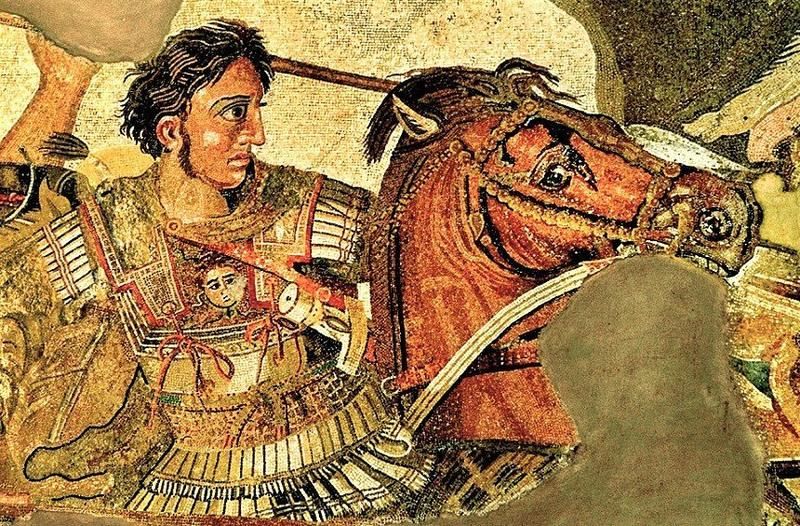


Alexander the Great


Wednesday, September 1, 2010

The Inward Cross - Hall Worthington


"It is a cross to a man's will to sit waiting on God, silently listening, struggling to keep his mind from wandering; it is a cross to a man's will to obey what he is commanded and taught by the Holy Spirit; this is the cross of which you must deny yourself and pick it up every day, to then follow Jesus. To obey his voice is to follow Jesus. This is how to do what you have prayed for a thousand times: thy will be done, on earth as it is in heaven. You cannot be his disciple unless you pick up your cross daily and follow his orders. Salvation is only received by those who follow the lamb wherever he goes - who obey completely the voice of the Lord, in whatever he commands."

--Hall Worthington

The Missing Cross to Purity
The Missing Cross