Showing posts with label Hobo. Show all posts

Monday, January 28, 2019

Book Review: The First Time I Rode a Freight Train & other hitchhiking stories


This is an email I received today from someone who gave me a ride a couple of times in Montana:

Hi Tim,

I picked up a copy of The First Time I Rode a Freight Train & Other Hitchhiking Stories at the Bitterroot Library [Hamilton, Montana] and just finished reading it. I feel like I know you quite well now, just from this account of what a few years on the road looked like for you.


One of my favorite chapters was "A Christmas Story or Junked Cars Can Be Beautiful". I actually read that just a few days before Christmas and it gave me a feeling that the Christmas story lives on in forms less obvious. In general, I really liked the meaning that you gave to roads, cars, and the people that drive them. As a car enthusiast myself, I have always loved wrenching and driving. I think I mentioned to you one of the times I picked you up that a few friends and I race an old BMW that we work on together. Likewise, searching for secluded, twisting backroads to really let our cars stretch their legs on and hug some corners has always been a special pastime with that same group of friends. Roads, cars, and the people that drive them have been important in my life, too; it was striking to see the completely different meaning that these things have in your life.

Also, in reading your book, I’ve given a lot of thought as to where God is trying to lead me. I believe that one can be led by the Spirit, even if not physically moving in a nomadic sense. I’ve had a lot of questions in my mind regarding the next step in my life - medical school. I applied to both M.D. and D.O. programs, but am struggling with a myriad of issues concerning which degree I should pursue. It wasn’t until I was nearly done with your book that I started to ask where God wants me to be. I am seeking His counsel.

--Alek Wood


Sunday, February 5, 2012

The First Time I Rode a Freight Train & other hitchhiking stories (excerpts)


The First Time I Rode a Freight Train & other hitchhiking stories
By Tim Shey 

Published January 2012
PublishAmerica
Baltimore 

Here are some excerpts from The First Time I Rode a Freight Train & other hitchhiking stories:

Page 8:  "The cop dropped me off in the middle of somewhere. It was ten o'clock at night, it was hot and humid and I forgot to fill up my water bottle back in Central City. I was not a happy camper. I thanked the officer for the ride and he turned around and drove west into the Nebraska night.

When the cop dropped me off, the last thing he said to me was, "Remember:  pray without ceasing."

"The next town was six miles away. So I walked past the corn fields and the hay fields of eastern Nebraska. I was thirsty. The noise of diesel engines roaring away pumping water into irrigation circles could be heard as I walked back east.

"Eventually, I made it to the small town of Duncan. I found a water hydrant and drank a ton of water. I then found a pickup parked next to the railroad tracks. I climbed into the cab of the pickup and slept there that night.

"The next morning, I walked to the shoulder of U.S. 30 and began thumbing for a ride to Columbus. Within half an hour, some guy walked up to the pickup that I had slept in the night before and drove off in it. Sometimes it is a good idea to get up early in the morning.

"I got a ride to Columbus. This guy took me to the bus station. I met a lady there that helped me pay for a bus ticket to Des Moines. I got on the bus and it went through Omaha. I got off in Adel, Iowa that evening. Adel is just west of Des Moines on U.S. 6.

"I phoned a friend in Ames. He picked me up in Adel and drove me back to Ames. He thought that it was funny that I hitchhiked to Nebraska and hopped a freight train. He thought it was really funny that a cop told me to get off the train. I didn't think it was so funny."

_____ 

Page 22:  "My backpack has shown a lot of wear and tear over the years. There are rips in it; it is somewhat dirty. There are places where I sewed it up with monofilament fishing line and there is a piece of duct tape on the bottom of the pack. Without duct tape, we would be a people no more.

"I believe the weight of my backpack averages around thirty-five pounds, so I get some good exercise every day when I have to walk several miles on the highway. The guy who gave me the backpack told me that he spent $200.00 for it back in 1979. It is still hanging in there pretty tough. It is an interior frame backpack. I don't know the brand name.

"It has been through rain, snow, dirt, mud, sand (e.g. I slept on the beach at Cambria, California), crude oil (in the back of a pickup in New Mexico), hundred-degree heat, and twenty-below-zero cold. I use it as a pillow when I sleep outside. I use it as body armor when somebody drives by and sprays me with submachine gun bullets (just joking). My body armor is a wall of fire that surrounds me--the Holy Ghost Fire.

"My backpack and I have hitchhiked countless thousands upon thousands of miles throughout the United States. Somebody once offered to buy me a new backpack two or three years ago. I graciously declined their offer. I'm going to keep this backpack as long as I can. You see, it never argues with me, it never disagrees with me, never talks back. It is very low maintenance. When I get tired of carrying it, I stop, take off my backpack and sit on it on the side of the road and rest for a while.

"When I die, it doesn't look like I will be able to take it to heaven with me--I guess this is something that I will just have to accept."

_____

Page 35:  "This past week I was hitchhiking in Montana and I ended up in Ennis. I went to the library and typed up some stuff on my Digihitch blog and then I walked to the Exxon gas station.

"I was inside the convenience store buying something to eat, when this older man walked up to me and asked, 'Are you the traveler? Is that your backpack out front?'

"I said, 'Yeah.'

"His name was Arthur and he said that he had done some hitchhiking in his younger days. He was originally from San Diego and did a lot of surfing at one time. Arthur used to hitchhike with a guitar. He asked me if I needed a place to stay for a while. He told me he needed some work done on his ranch and that he had a bad back; he had been in a real serious car crash years ago.

"So I told him that that would be great and that I would like to work for him. I grabbed my backpack and we drove around six miles to his ranch. He had a housemate named Hal who had lived there for five years; Hal was married and divorced and pretty much retired. Arthur used to be a miner years ago.

"I fed the horses hay and grain while I was there. Arthur and I hauled some garbage to the local dump and we did a lot of cleaning up of some trash in the house and rearranging some boxes for storage.

"I ended up staying two nights and then hit the road. I hitchhiked south and made it to Driggs, Idaho where I met up with a friend. I stayed at he and his wife's place in Drummond last night.

"Yesterday, I checked my email and Arthur sent me a very kind and thoughtful note; here it is below:

"'Hello Saw man we are glad in the lord and holy power for leading you to us. We are very much lovers of good men who follow the path in life that few dare to seek, I find in you the good warm energy that god has bestowed upon you, follow your path no one else can, and remember us in your prayers we shall forever be in your kindness and have no regrets for the time you and we shared with you. Be always welcome in our tee pee. We enjoyed you and the god & man energy to shared with us. Have a safe and full filled life and some day return to us that we may share what god has given us to share with his chosen few. you are special in our hearts and minds so be good to yourself and we will not judge you but find in you faith to carry on and struggle with our human condition and remain thankfull to god first and the life of mammon second.

"'your friends Arthur And Harold.
ps glad you liked my cooking. pax goldbear'" 

_____ 

The First Time I Rode a Freight Train & other hitchhiking stories
By Tim Shey
Paperback:  178 Pages
ISBN-10: 1462661718
ISBN-13: 978-1462661718
Language: English 

Sunday, August 15, 2010

Chris McCandless Revisited

Chris McCandless, 1968-1992

Dreams from the LORD 2007-2010
15 August 2010

Four days ago (11 August), I was hitchhiking in Idaho and this guy picked me up. He told me that he went to school at Emory University in Atlanta, Georgia; he graduated in 1994. So I asked him about Chris McCandless (Into the Wild by Jon Krakauer) (McCandless went to school at Emory).

This guy said that he was three years behind McCandless in school. After McCandless’ body was discovered in Alaska (1992), he was in an English class (in 1993?) with a professor that had taught McCandless a few years previous. The professor had the class study some of McCandless’ papers.

This guy told the professor and the class that he thought McCandless showed a lot of hubris or suburban hubris when he tried to live in the wilderness of Alaska; he thought that McCandless was not well-prepared to live on his own. The professor and the rest of the class reacted very negatively to this guy when he used the word “hubris.” This guy ended up getting a C- in the class.

Hubris: “n. [Gk., violence] Excessive pride: ARROGANCE.”
--Webster’s II New Riverside University Dictionary

Into the Wild by Jon Krakauer
The Jerry Shey Family
Few Thumbs Barred From Rides
Fairbanks Bus 142
Book Review:  High Plains Drifter
Into the Wild (2007) (Tragedy, Epiphany and Closure)
Chris McCandless on 20/20 (1997)
The Wild Truth by Carine McCandless

_____

I just discovered a couple of days ago that someone is trying to sell my manuscript (High Plains Drifter: A Hitchhiking Journey Across America) on Ebay.


I got a ride from Lolo, Montana to Orofino, Idaho on U.S. 12--I rode in the back of a pickup. I walked to the library in Orofino and googled "Tim Shey hitchhiker" just for the heck of it. One of the results was "Hitchhiking America/ Hiker Rage", so I clicked-on to it. I was surprised to see that someone was trying to sell my manuscript.

I thought it was pretty funny.

An American Pilgrim:  Some Reflections on High Plains Drifter
The First Time I Rode a Freight Train & other hitchhiking stories
The Short, Short Hitchhiker

The Life of a Hobo  
Hitchhiking Stories from Digihitch
Stobe the Hobo

Monday, August 2, 2010

Harry Truman, Hoboes and the Santa Fe Railroad


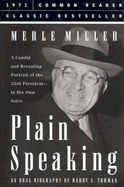
Harry S Truman (1884-1972) was the 33rd president of the United States. Below is an excerpt from Plain Speaking: An Oral Biography of Harry S Truman by Merle Miller.

Pages 41-43:

[Merle Miller] Mr. President, I understand that when you were still a boy, you got a job working as timekeeper for the Santa Fe Railroad.

[President Truman] "I worked for an old fellow named Smith, L.J. Smith his name was, and he was head of the construction company that was building the double track for the Santa Fe Railroad down here from Eaton Falls to where the Missouri Pacific comes into the Santa Fe down at Sheffield.

"I was eighteen years old, and I'd just finished high school and knew I wasn't going to get to go to West Point. So I took this job as a timekeeper. I took it to help out at home, to keep my brother, Vivian, and my sister, Mary, in school. My father was having a hard time with finances just then.

"Old man Smith had three camps, and there were about a hundred hoboes in each camp, and I got very well acquainted with them. My job was to keep tabs on them, to keep track of how much time they put in, and then I'd write out their paychecks for them. I'd usually write those checks in a saloon called Pogunpo's or in old man Schmidt's saloon in Sheffield. I used to sit there and pay off those hoboes. And they weren't bad fellows. They'd work for two weeks. They'd get discounted if they drew their checks before that time. So they'd work two weeks, and then they'd spend all their money for whiskey in the saloon and come back to work the next Monday morning. I'd pay them off on Saturday night.

"But they weren't bad fellows. Not in any way. Most of them had backgrounds that caused them to be hoboes. Either they'd had family troubles or they'd been in jail for some damn fool thing that wasn't a penitentiary offense. But they weren't bad citizens at all. I remember one time I told the old man that ran the saloon, he was an old Dutchman and wore whiskers, I told him, I said, 'This old bastard is the blacksmith out there on the railroad, and we need him. So try to cut out on his whiskey.'"

"Well, damn old Schmidt went out and told this blacksmith what I'd said, and I never got a better cussing in my life than I did for interfering with the freedom of an American citizen. And he was right. And that taught me something.

"But after that I guess the blacksmith was grateful for it because he took a file, a regular ordinary file about that long and made a butcher knife out of it and tempered it so that the edge would never come off. He made two of them for me, and I think one of them is still around the house somewhere. . . . So he didn't hold it against me that I was trying to keep him from getting drunk."

[Miller] When you said camps, what were they, houses or tents?

[Truman] "Tents mostly. There were tents, and I had a tricycle car on the railroad that I went up and down on. I had to make a list of the men that were working every morning at seven thirty, and then I had to go back at one thirty in the afternoon to be sure that they were still there. So when the time came for their being paid, I had the records. No one ever doubted the records I kept."

[Miller] How much did those men make?

[Truman] "They made eleven dollars for two weeks' work, and as I say, they'd get paid on Saturday, and by Monday morning most of them had drunk it all up. But it was one of the best experiences that I ever had because that was when I began to understand who the underdog was and what he thought about the people who were the high hats. They felt just like I did about them. They didn't have any time for them. And neither did I. I always liked the underdog better than the high hats. I still do."

[Miller] Weren't you ever uneasy? I mean, you were a reader of books and wore glasses and, as you say, you'd been called a sissy.

[Truman] "No. No. I never had any trouble with those birds. They were just as nice as they could be, and when I left, the foreman down there in Sheffield said, 'Harry's all right from the navel out in every direction.' Which when you come to think of it is just about the highest compliment I ever have been paid.

"Some of those hoboes had better educations than the president of Ha-vud University, and they weren't stuck up about it either. The average of them was just as smart as the smartest people in the country, and they'd had experiences, and a lot of them told me about their experiences. I hope I profited from it, and I think I did. I had to quit at the end of the summer, but my goodness. That was a great experience for me."

[Miller] I understand you learned a few cuss words that summer.

[Truman] "I did. The words some of those men knew I'd never heard before, but later when I was in the Army, there was an occasion or two when those words came in handy, and I used them.

"That experience also taught me that the lower classes so called are better than the high hats and the counterfeits, and they can be trusted more, too.

"About this counterfeit business. My Grandfather Young felt the same way. We had a church in the front yard where the cemetery is now. And the Baptists and the Methodists and all of them used it. And Grandfather Young when I was six years old, he died when I was eight, he told me that whenever the customers in any of those denominations prayed too loud in the Amen corner, you'd better go home and lock your smokehouse.

"And I found that to be true. I've never cared much for the loud pray-ers or for people who do that much going on about religion."

[Originally published by Digihitch.com]

Stobe the Hobo
The Life of a Hobo

Excerpts from "The Poor in Ames"

Iowa State University


By Bethany Kohoutek

Homelessness in Ames

Lurking underneath the seemingly affluent, professional surface of Ames [Iowa], there is a subculture of people whose problems are life and death and stories are rarely heard. While the ranks of homeless are spiraling out of control, mercilessly leaving less fortunate people behind, the same economic forces are propelling other Ames residents to wealth and prosperity. This is a story about those who aren't making the cut or don't want to in the first place, a story of the ups and downs of life on the road--or the street.


Homelessness is a word that the average Iowa State college student probably doesn't think twice about. But even as students gripe about waiting for CyRide buses in the cold, someone is sleeping under a bridge only blocks away using a plastic sheet to keep warm. As students complain about small dorm rooms and shared bathrooms, one family per day is evicted in Ames because it can't make rent.

Students from larger cities may scoff at the notion that homelessness and poverty are major issues in Ames. Although there is no one begging for spare change on Lincoln Way, homelessness does exist in Ames. The fact that it is less of a problem than in other, larger cities just makes it worse. Because it isn't thrown in your face every day, it's easy to forget about these people.

"If a tornado came through Ames and blew away a dozen homes, it would be front-page news," Moss [Vic Moss, executive director of the Emergency Residence Project] says. "And yet when we have this kind of devastation happening on a daily basis where families are being broken apart by this, it's not covered at all."

Moss estimates that there are around 50 homeless people each night in Ames. There is no one way to stereotype this population. Each situation is different, and Moss says the shelter sees everyone from "saints to sinners."

Life on the Road

Some people living in Ames without a home do have options. But according to them, street life is the best option.

At 4:15 on a Saturday afternoon, there are seven men congregated in the living room of the Emergency Adult Project adult shelter. They have just come back from work, and the atmosphere is laid back and comfortable as the men chat amiably with each other.

This population of single, transient men (and the occasional woman) makes up the majority of the shelter's clientele. These men come and go, with no intention of staying in Ames for any substantial amount of time. However, they make up a large percentage of Ames' homeless statistics. The difference between this population and other homeless children and families in Ames is that most of the men in the living room do not want to get into permanent housing, even if it was provided for them. They insist they're homeless by personal choice, not because of any particular hardship. The self-bestowed title of 'hobo' is a term of endearment to them. Some have road names like Duke and Bullet, and speak of fellow travelers with names like Little Lizzie, the Road King, and Dakota Butch.

These men usually come to shelters to take a temporary rest from their travels to "bathe, eat, sleep, be at peace, and still make a little money," says Bullet.

"There's a difference between 'without a home' and 'homeless,'" Bullet explains. "Most people don't even know what a real hobo is. A hobo is without a home because he chooses to be. He is a man who is a traveler at heart. He works. He has clothes. He has money in his pocket. If he wants prime rib for dinner, he can reach into his pocket and pay for it."

The men have various reasons for being on the road. Some have been on the road since their early teens, and it is all they know. Others may have gone through a divorce or lost a job. Still others may have had a steady job and a family, and simply "burned out" on the routine of day-to-day life.

"We don't want to settle down and accept the political society," says Bullet. "No president, no government is gonna tell us what we're gonna do. We will not be told 'You will get up at 6:00. You will get to work by 7:00. You will punch the clock by 7:01. Then you will punch out at 3:30.' It's monotony. With us, that just doesn't work. Everyday is a new adventure. We are one of the last signs of real, true freedom."

Duke, who is 57 years old, "rides the rails" to get from place to place.

He left home at 14 because he wanted to travel--to see the country, meet new people, and because "it's a lot easier and a lot more mellow this way." He has four children and seven grandchildren who live in various places around the country. He occasionally sees them when he is in the neighborhood. If he gets bored staying in one place too long, it doesn't take much for him to "kick mud", to move on. He says he has been to every state in the contiguous United States as well as Mexico and Canada. He likes Iowa because people seem outgoing and friendly to him.

Shelter stays are fairly uncommon for him; he would rather sleep outside in his tent, even in the winter.

"I've been out here so long, I know how to live out in this. It's all just experience," he says.

Wherever he goes, he carries a 65-pound pack on his back that holds his tent, a change of clothes, campfire-making materials, a flashlight, string, a bedroll, a tarp, and a folded up sign that says "Will Work For Food. Thanks. God Bless." Most of his money is spent on groceries and tobacco, and besides his smokers' cough, he says he rarely gets sick.

Others have entirely different reasons for traveling.

Tim, who is one of the younger men in the shelter's living room, graduated from Iowa State with a degree in English. He actually had two religious poems and a short story published in Ethos. He said that in the future he plans to settle down, get married and have a family.

"I'm a Christian; I hitchhike by faith," he says. "I am being led by the Holy Spirit wherever I go. I share my faith with other people. I've met a lot of great people, and I've learned a lot from them. In fact, these pants were given to me by a family in Texas. My coat was given to me by a guy in Wyoming. Things like that. You meet so many neat people. I can't complain."


Hearing Tim talk, Bullet is quick to interject that things aren't always so easy going on the road.

"Everybody always tries to glorify it. You don't hear about the nights under the bridge, or sleeping alongside the interstate in the rain and cold. You don't hear about standing out there on a ramp when it is 35 below zero wind chill, and you got frost formed to your mustache and your hair. It can be real tough, lonely, scary. That's the downside."

"I think Bob Seger said it best," says Bullet, "'Turn the page.' Life's a book. Each day you turn the page to something different. It could be great, or it could be a real sh*thole."

Moss says that usually during summer months, there are some people who live under bridges, along the railroad, and in the wooded areas of Ames.

There is one such place under a bridge not far from campus. Plywood and plastic sheeting have been set up to make a little lean-to against the girders of the underside of the bridge. Bags of collected cans and bottles surround a green sleeping bag that is neatly laid out on the dirt. Nearby is a blackened spot in the dirt, which still smells of charcoal and lighter fluid, and various food cans are scattered around the fire pit.

There is a greening picture of Jesus looking heavenward duck-taped to the cement that forms the back wall of the makeshift dwelling. A six-inch angel statue, in perfect condition, is standing upright on the ground nearby, surrounded by other miscellaneous items--Hy-Vee Charcoal Starters, an empty pack of Camel lights, a few bottles of Hawkeye vodka, an old pair of jeans, and a few T-shirts.

Ethos
Issue 3, Volume 52
February 2001
Iowa State University

[Originally published by Digihitch.com]

High Plains Drifter (short story)
Shiloh
A Prophet's Eyes
A Prophetess from Minnesota
Hobo Shoestring--King of the Rails
Ethos/Greenlee School of Journalism and Communication
The Life of a Hobo
A Thumb and a Prayer
A Red-Letter Day
Stobe the Hobo


Ames, Iowa

The First Time I Rode A Freight Train (short story)


Back in July of 1980, I was house sitting for some friends in Ames, Iowa. They and their two daughters were gone for a month or so seeing relatives in Southern California.

One day I decided to hit the road and see how far west I could get. I took my backpack and some of my belongings and began hitchhiking west on U.S. 30.

I got a few rides to Denison. Then this young lady picked me up near Dow City or Dunlap. She had a can of beer in her hand and offered me one; I declined the offer. I went to enough beer parties in high school; my beer-drinking days were pretty much over. She was fairly drunk and she would swerve over into the other lane every so often and then correct herself.

Finally, I said, "Hey, if you want, I can drive for you."

She said, "No. I'm doing just fine."

A few minutes later she barely missed hitting this tractor-trailer coming from the opposite direction.

I had had enough, so I said, "Pull over and let me out."

She pulled over onto the shoulder and I got out of the car. She gave me the finger and drove off. I was so glad to get out of that vehicle. That was the first time (and maybe the only time) I asked to get out of a car because the driver was drunk.

So I walked down the road and this guy picked me up. He had just graduated from the veterinary school at Iowa State University in Ames. This guy was going to Nebraska to take his boards for the state of Nebraska.

He dropped me off someplace and I later made it to Blair, Nebraska. The sun was setting as I walked down main street. I walked past this gas station and this kid that worked there was sitting in a chair.

He looked at my backpack and asked, "Where ya goin'?"

"I'm heading out west," I replied.

"Have a good trip."

"Thanks."

I walked through Blair and was a mile or so out of town, when a sheriff deputy stopped me. He asked me where I was going and then he checked my ID. At the time, I was a little annoyed that they would stop and check me. I was walking down the road minding my own business. What's the big deal, I thought. That was probably the first time I had been stopped by law enforcement for walking or hitchhiking. I was a little rattled about the whole thing.

The sheriff deputy gave me my ID back and I continued walking due west on U.S. 30.

The sun was down, so I decided to jump over this fence and hightail it to the railroad tracks. It wasn't long and I was walking down the tracks of the Union Pacific.

I had been walking for a while when all of a sudden this powerful light came around the bend behind me and this locomotive was bearing down on me! I didn't even hear it coming! I took evasive action, quickly jumped off the tracks and ran into the ditch. The four or five engines roared past with its grain cars in tow. That was a close one, I thought.

I later learned that the sound of the engine travels out from the sides of the locomotive, not from the front. I had been hitchhiking in New Mexico back in the late 1990s, when this man and his wife and kids picked me up. He worked as a welder for the Santa Fe Railroad. He told me about the sound traveling out from the sides and not from the front. He and his fellow welder almost got run over by a train while they were welding "frogs" on the tracks. They never heard the train coming--just like in my case.

So I continued to walk down the tracks. I then camped out in some grass. It was hot and humid--it was probably in the upper nineties that day. The mosquitoes were bad. I don't think I got much sleep that night.

The next morning I got a couple of rides to Fremont.

I was walking in downtown Fremont heading towards the railroad tracks (I was thinking about hopping a freight train) when a local cop stopped me.

"Where you going, son?" he asked.

"I'm heading west," I said.

"You're going in the wrong direction. Hop in and I'll give you a ride west of town."

"Sounds good."

He dropped me off near this pond of water; it looked like a state park or campsite. I thanked him for the ride and he drove off.

It was now around a hundred degrees and I was getting hot, so I spent some time swimming in the pond. After a while, I lay down on this picnic table and took a nap for an hour or two.

Then I heard this low rumbling. I woke up and saw this freight train slowly moving westward on the tracks maybe a hundred yards away. I quickly put on my socks and boots and grabbed my backpack and ran to this brand, spanking-new flatcar. It had my name written all over it.

I climbed onto the flatcar and put my backpack against the bulkhead. I sat down and rested my back against my backpack. The train merged from the siding onto the main line and gained some speed. I was now in business.

It was exhilarating and free, sitting on that flatcar watching the green Nebraska countryside go past. Eventually, I took off my boots and socks and sat on the flatcar barefoot. I felt even more free. The train was now traveling at around fifty miles per hour.

The Union Pacific tracks ran parallel with U.S. 30. Cars and pickups would drive down the highway and people would wave at me and laugh. I would wave back and smile. Some people would honk their horns. It was a lot of fun.

The train rolled through North Bend and Schuyler and finally slowed down and stopped in Columbus. We weren't stopped very long. They were switching out some cars, I'm guessing.

The train slowly moved out and we were heading west again.

My plan, when I left Ames, was to see some relatives in Ogallala, Nebraska. Well, I didn't know their names and I didn't know exactly where they lived in Ogallala. I just knew that I had some relatives in Ogallala and this is why I headed west. It doesn't make a whole lot of sense now, but back then I was twenty years old and all I wanted was an excuse to hit the road and head west. Relatives in Ogallala: sounds good to me. (I later did meet these relatives in Ogallala back in 1983--just before I hitchhiked to California for the first time.)

The train was now going down the tracks at a pretty good clip. I was absolutely enjoying everything about life on a flatcar when I saw this Nebraska Highway Patrol drive by on U.S. 30. I smiled and waved at him, but he didn't wave back. He gave me a dirty look. It was then that I began to think that maybe I wasn't supposed to be riding this freight train.

I didn't think it was illegal to hop freight trains (but that maybe some people might frown on it). My great-grandfather, who was born in County Roscommon in Ireland, lived for seventeen years in Australia herding sheep and prospecting for gold. He came to America and settled down in southwest Iowa. He used to ride freight trains between Iowa and western Nebraska all the time. But that was back in the late 1800s and early 1900s. I began to think that sitting on this flatcar in plain sight of everybody was not such a good idea.

The train rolled through Central City and soon began to slow down. As the train slowly made its way through the small town of Chapman, there was this cop in his car stopped at the intersection. I smiled and waved at him, but he didn't wave back. Then I began to get this sinking feeling. Maybe I better get off of this train ASAP.

Well, the train stopped maybe a quarter of a mile from where the cop was sitting. I saw the cop car back up and drive down the service road that ran parallel with the tracks. He stopped his car next to my flatcar and motioned for me to get off the train.

I looked at him and said, "Who me?"

He nodded his head as if to say, "Yes, you."

I put my socks and boots back on and climbed off of the flatcar. I didn't like this one bit.

I got in the car and the cop told me that it was illegal to ride freight trains. He drove me to Central City to the police station. He said that he was going to contact the "U.P." (Union Pacific) detectives and see if they wanted to prosecute me.

I sat at the police station as the officer phoned the Union Pacific. The guys in the jail asked me why I was there. I told them that I got caught riding a freight train. They howled in laughter. I sort of laughed, but not really.

The officer hung up the phone and told me that the Union Pacific didn't want to prosecute. He told me to get back in the car and that he would drive me east to the county line.

As we drove east on U.S. 30, the cop asked, "So Tim, do you ever think about where you will go when you die?"

I answered, "Yeah, I think about it all the time."

So he began to tell me about Jesus and the Gospel. We had an intense talk. I was not yet a Christian, but this cop definitely sowed some good seeds into me. I asked Christ into my life two years later. Getting caught on a freight train by a Christian cop was definitely the hand of God--but I didn't know it at the time.

I was restless and seeking something: truth, beauty, literary aspirations, freedom from Adamic slavery. I dropped out of high school twice because it was so oppressive and unchallenging. I was hungry and desperate. Heaven was on my mind. I was looking for God, but did not know how to truly access Him. In July 1980, I was not far from the Kingdom of Heaven.

The cop dropped me off in the middle of somewhere. It was ten o'clock at night, it was hot and humid and I forgot to fill up my water bottle back in Central City. I was not a happy camper. I thanked the officer for the ride and he turned around and drove west into the Nebraska night.

When the cop dropped me off, the last thing he said to me was, "Remember:  pray without ceasing."

The next town was six miles away. So I walked past the corn fields and the hay fields of eastern Nebraska. I was thirsty. The noise of diesel engines roaring away pumping water into irrigation circles could be heard as I walked back east.

Eventually, I made it to the small town of Duncan. I found a water hydrant and drank a ton of water. I then found a pickup parked next to the railroad tracks. I climbed into the cab of the pickup and slept there that night.

The next morning, I walked to the shoulder of U.S. 30 and began thumbing for a ride to Columbus. Within half an hour, some guy walked up to the pickup that I had slept in the night before and drove off in it. Sometimes it is a good idea to get up early in the morning.

I got a ride to Columbus. This guy took me to the bus station. I met a lady there that helped me pay for a bus ticket to Des Moines. I got on the bus and it went through Omaha. I got off in Adel, Iowa that evening. Adel is just west of Des Moines on U.S. 6.

I phoned a friend in Ames. He picked me up in Adel and drove me back to Ames. He thought that it was funny that I hitchhiked to Nebraska and hopped a freight train. He thought it was really funny that a cop told me to get off the train. I didn't think it was so funny.

[Originally published by Digihitch.com]

Hoboes That Pass in the Night
Hobo Shoestring - King of the Rails
The Life of a Hobo
Hitchhiking Stories from Digihitch 
The Road
Stobe the Hobo

Monday, June 14, 2010

Into The Wild by Jon Krakauer


Two days ago I finally finished reading Jon Krakauer's Into The Wild. I read the first five or six chapters at a bookstore in Driggs, Idaho; I finished reading it here at the public library in Dubois, Wyoming. I liked the book a lot. Eventhough, the death of Chris McCandless was a tragedy, I believe that the two years of his life before his death were redeeming. He experienced more in two years than most people experience in a lifetime. He lived "deliberately" as Henry David Thoreau would have said.

Krakauer writes extensively on his own life and experiences. Krakauer was trying to draw a parallel between his strained relationship with his dad and Chris McCandless' difficult relationship with Walt McCandless. When McCandless found out about his dad's other wife and children, it seemed like he had been living a lie--maybe McCandless felt he was illegitimate: it wounded him deeply. This deep wounding partly drove him into the wild, onto the edge, the fringes of society.

The main reason McCandless hitchhiked, rode freight trains and ended up in the wilderness of Alaska was to prove to himself that he could survive on his own. Krakauer writes of his own mountain climbing experiences; he was young and he wanted to prove to himself that he could climb the mountain and survive some near-death experiences.

At first glance, I thought, how does mountain climbing compare with hitchhiking? Isn't it much more dangerous to climb mountains than to hitchhike? At second glance, people die climbing mountains and people die hitchhiking the highways of the world. Mountain climbers explore and hitchhikers explore: they explore new geographical territory and terrain and they explore their own limits in difficult environments.

McCandless was obviously a very well-read young man. I liked the quotes of various writers at the beginning of each chapter in Into The Wild. McCandless left a deep and lasting impression on many people in his travels. Ron Franz, the old guy McCandless met in southern California, was especially touched by his life. I don't see any evidence that McCandless had a relationship with Jesus Christ, but he did believe in God.

When a man of ninety-five dies, people say that he lived a long life and that it was time for him to go. When a young man like McCandless dies at the age of twenty-four, we say it was a tragedy that he died so young. Tragedy is in the eye of the beholder. Yes, I would rather that McCandless had survived his ordeal in the Alaskan wilderness, but he lived more in twenty-four years than some people would live in two hundred years. People have and will learn from McCandless' life and death. It is not how long you live your life, but it is the quality of the life you lived that is important.

People will be reading and writing about McCandless' life for years to come. I saw the film Into The Wild for the first time last summer; the cinematography is beautiful--I liked the movie a lot. The hitchhiking scenes in the movie reminded me of my own hitchhiking experiences: the people you meet on the road, sleeping in the desert, the odd jobs you get to make a little money. I may have hitchhiked more miles than McCandless, but he rode more freight trains than I ever will.

I was hitchhiking through Belle Fourche, South Dakota a couple of years ago and this lady picked me up. She told me that she and her boyfriend picked up McCandless while he was hitchhiking through South Dakota back in 1992.

I believe the Lord wanted me to read Into The Wild for a reason. There are similarities and differences between my life and McCandless' life. I did a lot of exploratory hitchhiking back in 1986 and 1987, but since 1996, my hitchhiking has been God's will for my life--this is my work: obeying the Lord on the road.

Genesis 47: 9: "And Jacob said unto Pharaoh, The days of my pilgrimage are an hundred and thirty years: few and evil have the days of the years of my life been, and have not attained unto the days of the years of the life of my fathers in the days of their pilgrimage."

Jacob's pilgrimage ended when he was one hundred and forty-seven years old (Genesis 47: 28); Chris McCandless' pilgrimage ended when he was twenty-four; I am still a pilgrim on this earth.

"When the Stranger says: 'What is the meaning of this city?
Do you huddle close together because you love each other?'
What will you answer? 'We all dwell together
To make money from each other'? or 'This is a community'?
And the Stranger will depart and return to the desert.
O my soul, be prepared for the coming of the Stranger,
Be prepared for him who knows how to ask questions."

--T.S. Eliot

Matthew 8: 20: "And Jesus saith unto him, The foxes have holes, and the birds of the air have nests; but the Son of man hath not where to lay his head."


Chris McCandless Revisited
Fairbanks Bus 142
Into the Wild (2007) (Tragedy, Epiphany and Closure)
A Critical Review of Into the Wild
Chris McCandless on 20/20 (1997)
The Wild Truth by Carine McCandless
Hitchhiking Stories from Digihitch
Stobe the Hobo