Tuesday, August 31, 2010

When I Came to Destroy the City

Prophet Ezekiel
Dreams from the LORD 2007-2010
25 August 2010

Ezekiel 43: 3: “And it was according to the appearance of the vision which I saw, even according to the vision that I saw when I came to destroy the city: and the visions were like the vision that I saw by the river Chebar; and I fell upon my face.”

“When I came to destroy the city.”

I have read the Book of Ezekiel many times over the years, but it wasn’t until a couple of days ago that I noticed this Scripture in Ezekiel 43: 3: “When I came to destroy the city.” This is very intriguing to me. Why haven’t I noticed this before? I know that the Lord is in the details of our lives, so why did I first notice this a couple of days ago? Is the Lord trying to show me something?

If this Scripture in Ezekiel 43 had said, “The Lord told me that HE would destroy the city”, then I would say, Amen—so be it—it makes perfect sense to me as a Christian. But to say “when I came to destroy the city” is a horse of a different color.

I know that if a prophet is truly submitted to the Lord, the Lord can use his eyes, ears, mouth, body, life, circumstances and anything else to get his attention or the attention of the people that he is trying to communicate to. Example: the Lord had Isaiah walk naked throughout Egypt for three years; Isaiah’s life was a warning to Egypt (to be naked means that you are living in sin).

The Lord has had me hitchhike throughout the United States for most of fourteen years now. I have talked to a lot of people about my Christian faith, but intercession is my main work. I do believe that the deeper message is my life of obedience to the Lord: I am hitchhiking because the Lord told me to, NOT because I want to. “Not my will, but Thine be done.” So my hitchhiking IS the sermon. If I was not able to speak about Jesus, I would still be preaching the Kingdom because I am obeying the Lord.

About ten years ago, I was walking in this grove of trees back in Iowa and the Holy Spirit came upon me very powerfully and all of a sudden these words came out of my mouth: “I hate this place [that piece of property]. This place is built on sin.” The property that I was walking on was owned by a man who was very anti-Christian. Later that night, the Lord had me rebuke him for his sinful lifestyle. It was all done in the power of the Holy Ghost. After I was done rebuking him, there was perfect peace in my spirit; the burden in my spirit was lifted and I was free to leave.

The last time I hitchhiked through Las Vegas, I told the Lord that I hated that place and I asked Him not to have me hitchhike through Las Vegas again. That was in December of 2005. I haven’t seen Las Vegas since.

“When I came to destroy the city.”

Numbers 12: 6: “And he said, Hear now my words: If there be a prophet among you, I the LORD will make myself known unto him in a vision, and will speak unto him in a dream.”

Las Vegas Earthquake
California Earthquake
Jackson, Wyoming Fire, 2012
A Vision about George Washington and America

Monday, August 30, 2010

The Cross of Christ by Watchman Nee


17 August 2010

The Normal Christian Life by Watchman Nee
Chapter 2: “The Cross of Christ”:

Page 34: “So we see that objectively the Blood deals with our sins. The Lord Jesus has borne them on the Cross for us as our Substitute and has thereby obtained for us forgiveness, justification and reconciliation. But we must now go a step further in the plan of God to understand how he deals with the sin principle in us. The Blood can wash away my sins, but it cannot wash away my ‘old man.’ It needs the Cross to crucify me. The Blood deals with the sins, but the Cross must deal with the sinner.”

Pages 35-36: “How were we constituted sinners? By Adam’s disobedience. We do not become sinners by what we have done but because of what Adam has done and has become. I speak English, but I am not thereby constituted an Englishman. I am in fact a Chinese. So chapter 3 draws our attention to what we have done—‘all have sinned’—but it is nevertheless not because we have done it that we become sinners.

“I once asked a class of children, ‘Who is a sinner?’ and their immediate reply was, ‘One who sins.’ Yes, one who sins is a sinner, but the fact that he sins is merely the evidence that he is already a sinner; it is not the cause. One who sins is a sinner, but it is equally true that one who does not sin, if he is of Adam’s race, is a sinner too, and in need of redemption. Do you follow me? There are bad sinners and there are good sinners, there are moral sinners and there are corrupt sinners, but they are all alike sinners. We sometimes think that if only we had not done certain things all would be well; but the trouble lies far deeper than in what we do: it lies in what we are. A Chinese may be born in America and be unable to speak Chinese at all, but he is a Chinese for all that, because he was born a Chinese. It is birth that counts. So I am a sinner because I am born in Adam. It is a matter not of my behavior but of my heredity, my parentage. I am not a sinner because I sin, but I sin because I come from the wrong stock. I sin because I am a sinner.

“We are apt to think that what we have done is very bad, but that we ourselves are not so bad. God is taking pains to show us that we ourselves are wrong, fundamentally wrong. The root trouble is the sinner; he must be dealt with. Our sins are dealt with by the Blood, but we ourselves are dealt with by the Cross. The Blood procures our pardon for what we have done; the Cross procures our deliverance from what we are.”

The Spiritual Man

Friday, August 20, 2010

Tolstoy and Dostoyevsky

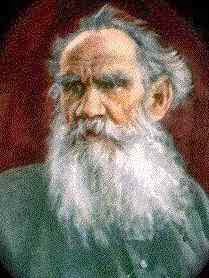
Leo Tolstoy, 1828-1910
Dreams from the LORD 2007-2010
16 August 2010

An excerpt from The Jesus I Never Knew by Philip Yancey:

Pages 140-142: “A.N. Wilson, a biographer of Tolstoy, remarks that Tolstoy suffered from a ‘fundamental theological inability to understand the Incarnation. His religion was ultimately a thing of Law rather than of Grace, a scheme for human betterment rather than a vision of God penetrating a fallen world.’ With crystalline clarity Tolstoy could see his own inadequacy in the light of God’s Ideal. But he could not take the further step of trusting God’s grace to overcome that inadequacy.

“Shortly after reading Tolstoy I discovered his countryman Fyodor Dostoyevsky. These two, the most famous and accomplished of all Russian writers, lived and worked during the same period of history. Oddly, they never met, and perhaps it was just as well—they were opposites in every way. Where Tolstoy wrote bright, sunny novels, Dostoyevsky wrote dark and brooding ones. Where Tolstoy worked out ascetic schemes for self-improvement, Dostoyevsky periodically squandered his health and fortune on alcohol and gambling. Dostoyevsky got many things wrong, but he got one thing right: His novels communicate grace and forgiveness with a Tolstoyan force.

“Early in his life, Dostoyevsky underwent a virtual resurrection. He had been arrested for belonging to a group judged treasonous by Tsar Nicholas I, who, to impress upon the young parlor radicals the gravity of their errors, sentenced them to death and staged a mock execution. The conspirators were dressed in white death gowns and led to a public square where a firing squad awaited them. Blindfolded, robed in white burial shrouds, hands bound tightly behind them, they were paraded before a gawking crowd and then tied to posts. At the very last instant, as the order, ‘Ready, aim!’ was heard and rifles were cocked and lifted upward, a horseman galloped up with a pre-arranged message from the tsar: he would mercifully commute their sentence to hard labor.

“Dostoyevsky never recovered from this experience. He had peered into the jaws of death, and from that moment life became for him precious beyond all calculation. ‘Now my life will change,’ he said; ‘I shall be born again in a new form.’ As he boarded the convict train toward Siberia, a devout woman handed him a New Testament, the only book allowed in prison. Believing that God had given him a second chance to fulfill his calling, Dostoyevsky pored over that New Testament during his confinement. After ten years he emerged from exile with unshakeable Christian convictions, as expressed in one famous passage, ‘If anyone proved to me that Christ was outside the truth . . . then I would prefer to remain with Christ than with the truth.’

“Prison offered Dostoyevsky another opportunity as well. It forced him to live at close quarters with thieves, murderers, and drunken peasants. His shared life with these people later led to unmatched characterizations in his novels, such as that of the murderer Raskolnikov in Crime and Punishment. Dostoyevsky’s liberal view of the inherent goodness in humanity shattered in collision with the granitic evil he found in his cellmates. Yet over time he also glimpsed the image of God in even the lowest of prisoners. He came to believe that only through being loved is a human being capable of love; ‘We love because he [God] first loved us,’ as the apostle John says.

“I encountered grace in the novels of Dostoyevsky. Crime and Punishment portrays a despicable human being who commits a despicable crime. Yet grace enters Raskolnikov’s life as well, through the person of the converted prostitute Sonia, who follows him all the way to Siberia and leads him to redemption. The Brothers Karamazov, perhaps the greatest novel ever written, draws a contrast between Ivan the brilliant agnostic and his devout brother Alyosha. Ivan can critique the failures of humankind and every political system devised to deal with those failures, but he can offer no solutions. Alyosha has no solutions for the intellectual problems Ivan raises, but he has a solution for humanity: love. ‘I do not know the answer to the problem of evil,’ said Alyosha, ‘but I do know love.’ Finally, in the magical novel The Idiot, Dostoyevsky presents a Christ figure in the form of an epileptic prince. Quietly, mysteriously, Prince Myshkin moves among the circles of Russia’s upper class, exposing their hypocrisy while also illuminating their lives with goodness and truth.

“Taken together, these two Russians became for me, at a crucial time in my Christian pilgrimage, spiritual directors. They helped me come to terms with a central paradox of the Christian life. From Tolstoy I learned the need to look inside, to the kingdom of God that is within me. I saw how miserably I had failed the high ideals of the gospel. But from Dostoyevsky I learned the full extent of grace. Not only the kingdom of God is within me; Christ himself dwells there. ‘Where sin increased, grace increased all the more,’ is how Paul expressed it in Romans.

“There is only one way for any of us to resolve the tension between the high ideals of the gospel and the grim reality of ourselves: to accept that we will never measure up, but that we do not have to. We are judged by the righteousness of the Christ who lives within, not our own. Tolstoy got it halfway right: anything that makes me feel comfort with God’s moral standard, anything that makes me feel, ‘At last I have arrived,’ is a cruel deception. But Dostoyevsky got the other half right: anything that makes me feel discomfort with God’s forgiving love is also a cruel deception. ‘There is now no condemnation for those who are in Christ Jesus’: that message, Leo Tolstoy never fully grasped.”


Fyodor Dostoyevsky, 1821-1881


Fyodor Dostoyevsky
The Prophet
A Single Story of Soviet Russia
Vintage Footage of Leo Tolstoy
Mark Taylor's Prophetic Word on Russia and the United States (10-30-16)
Fyodor Dostoyevsky - A good summary of his life


"Harvest" (1915) by Zinaida Serebriakova


"Neskuchnoye--Field" (1912) by Zinaida Serebriakova


"Harvest" (1910) by Zinaida Serebriakova

Sunday, August 15, 2010

Chris McCandless Revisited

Chris McCandless, 1968-1992

Dreams from the LORD 2007-2010
15 August 2010

Four days ago (11 August), I was hitchhiking in Idaho and this guy picked me up. He told me that he went to school at Emory University in Atlanta, Georgia; he graduated in 1994. So I asked him about Chris McCandless (Into the Wild by Jon Krakauer) (McCandless went to school at Emory).

This guy said that he was three years behind McCandless in school. After McCandless’ body was discovered in Alaska (1992), he was in an English class (in 1993?) with a professor that had taught McCandless a few years previous. The professor had the class study some of McCandless’ papers.

This guy told the professor and the class that he thought McCandless showed a lot of hubris or suburban hubris when he tried to live in the wilderness of Alaska; he thought that McCandless was not well-prepared to live on his own. The professor and the rest of the class reacted very negatively to this guy when he used the word “hubris.” This guy ended up getting a C- in the class.

Hubris: “n. [Gk., violence] Excessive pride: ARROGANCE.”
--Webster’s II New Riverside University Dictionary

Into the Wild by Jon Krakauer
The Jerry Shey Family
Few Thumbs Barred From Rides
Fairbanks Bus 142
Book Review:  High Plains Drifter
Into the Wild (2007) (Tragedy, Epiphany and Closure)
Chris McCandless on 20/20 (1997)
The Wild Truth by Carine McCandless

_____

I just discovered a couple of days ago that someone is trying to sell my manuscript (High Plains Drifter: A Hitchhiking Journey Across America) on Ebay.


I got a ride from Lolo, Montana to Orofino, Idaho on U.S. 12--I rode in the back of a pickup. I walked to the library in Orofino and googled "Tim Shey hitchhiker" just for the heck of it. One of the results was "Hitchhiking America/ Hiker Rage", so I clicked-on to it. I was surprised to see that someone was trying to sell my manuscript.

I thought it was pretty funny.

An American Pilgrim:  Some Reflections on High Plains Drifter
The First Time I Rode a Freight Train & other hitchhiking stories
The Short, Short Hitchhiker

The Life of a Hobo  
Hitchhiking Stories from Digihitch
Stobe the Hobo

Wednesday, August 4, 2010

Death at Ramoth-gilead


I Kings 22: 1-38: "And they continued three years without war between Syria and Israel. And it came to pass in the third year, that Jehoshaphat the king of Judah came down to the king of Israel. And the king of Israel said unto his servants, Know ye that Ramoth in Gilead is ours, and we be still, and take it not out of the hand of the king of Syria? And he said unto Jehoshaphat, Wilt thou go with me to battle to Ramoth- gilead? And Jehoshaphat said to the king of Israel, I am as thou art, my people as thy people, my horses as thy horses. And Jehoshaphat said unto the king of Israel, Enquire, I pray thee, at the word of the LORD to day. Then the king of Israel gathered the prophets together, about four hundred men, and said unto them, Shall I go against Ramoth-gilead to battle, or shall I forbear? And they said, Go up; for the Lord shall deliver it into the hand of the king. And Jehoshaphat said, Is there not here a prophet of the LORD besides, that we might enquire of him?And the king of Israel said unto Jehoshaphat, There is yet one man, Micaiah the son of Imlah, by whom we may enquire of the LORD: but I hate him; for he doth not prophesy good concerning me, but evil. And Jehoshaphat said, Let not the king say so. Then the king of Israel called an officer, and said, Hasten hither Micaiah the son of Imlah. And the king of Israel and Jehoshaphat the king of Judah sat each on his throne, having put on their robes, in a void place in the entrance of the gate of Samaria; and all the prophets prophesied before them. And Zedekiah the son of Chenaanah made him horns of iron: and he said, Thus saith the LORD, With these shalt thou push the Syrians, until thou have consumed them. And all the prophets prophesied so, saying, Go up to Ramoth-gilead, and prosper: for the LORD shall deliver it into the king’s hand. And the messenger that was gone to call Micaiah spake unto him, saying, Behold now, the words of the prophets declare good unto the king with one mouth: let thy word, I pray thee, be like the word of one of them, and speak that which is good. And Micaiah said, As the LORD liveth, what the LORD saith unto me, that will I speak.

"So he came to the king. And the king said unto him, Micaiah, shall we go against Ramoth-gilead to battle, or shall we forbear? And he answered him, Go, and prosper: for the LORD shall deliver it into the hand of the king. And the king said unto him, How many times shall I adjure thee that thou tell me nothing but that which is true in the name of the LORD? And he said, I saw all Israel scattered upon the hills, as sheep that have not a shepherd: and the LORD said, These have no master: let them return every man to his house in peace. And the king of Israel said unto Jehoshaphat, Did I not tell thee that he would prophesy no good concerning me, but evil? And he said, Hear thou therefore the word of the LORD: I saw the LORD sitting on his throne, and all the host of heaven standing by him on his right hand and on his left. And the LORD said, Who shall persuade Ahab, that he may go up and fall at Ramoth-gilead? And one said on this manner, and another said on that manner. And there came forth a spirit, and stood before the LORD, and said, I will persuade him. And the LORD said unto him, Wherewith? And he said, I will go forth, and I will be a lying spirit in the mouth of all his prophets. And he said, Thou shalt persuade him, and prevail also: go forth, and do so. Now therefore, behold, the LORD hath put a lying spirit in the mouth of all these thy prophets, and the LORD hath spoken evil concerning thee. But Zedekiah the son of Chenaanah went near, and smote Micaiah on the cheek, and said, Which way went the Spirit of the LORD from me to speak unto thee? And Micaiah said, Behold, thou shalt see in that day, when thou shalt go into an inner chamber to hide thyself. And the king of Israel said, Take Micaiah, and carry him back unto Amon the governor of the city, and to Joash the king’s son; And say, Thus saith the king, Put this fellow in the prison, and feed him with bread of affliction and with water of affliction, until I come in peace. And Micaiah said, If thou return at all in peace, the LORD hath not spoken by me. And he said, Hearken, O people, every one of you. So the king of Israel and Jehoshaphat the king of Judah went up to Ramoth-gilead. And the king of Israel said unto Jehoshaphat, I will disguise myself, and enter into the battle; but put thou on thy robes. And the king of Israel disguised himself, and went into the battle. But the king of Syria commanded his thirty and two captains that had rule over his chariots, saying, Fight neither with small nor great, save only with the king of Israel. And it came to pass, when the captains of the chariots saw Jehoshaphat, that they said, Surely it is the king of Israel. And they turned aside to fight against him: and Jehoshaphat cried out. And it came to pass, when the captains of the chariots perceived that it was not the king of Israel, that they turned back from pursuing him. And a certain man drew a bow at a venture, and smote the king of Israel between the joints of the harness: wherefore he said unto the driver of his chariot, Turn thine hand, and carry me out of the host; for I am wounded. And the battle increased that day: and the king was stayed up in his chariot against the Syrians, and died at even: and the blood ran out of the wound into the midst of the chariot. And there went a proclamation throughout the host about the going down of the sun, saying, Every man to his city, and every man to his own country.

"So the king died, and was brought to Samaria; and they buried the king in Samaria. And one washed the chariot in the pool of Samaria; and the dogs licked up his blood; and they washed his armour; according unto the word of the LORD which he spake."

The preceding Scriptures describe the sinful condition of the United States in 2010. There is definitely an Ahab spirit and a Jezebel spirit at work in this country that are opposing the works of God or the anointing of the Holy Ghost (Elijah). An Ahab spirit is a weak man; a Jezebel spirit is a domineering woman. The Lord created man to be masculine and woman to be feminine and the woman to be submissive to the man. Satan loves to pervert and corrupt what God has created. This sinful condition is leading to God's wrath--not unlike King Ahab's death at Ramoth-gilead where "the dogs licked up his blood."

According to Scripture, the life is in the blood. Leviticus 17: 11: "For the life of the flesh is in the blood: and I have given it to you upon the altar to make an atonement for your souls: for it is the blood that maketh an atonement for the soul."

Ahab was so sinful, he was lower than a dog.

Sin entered the Garden of Eden and the human race because Adam was passive.

Judges 6: 1: "And the children of Israel did evil in the sight of the LORD: and the LORD delivered them into the hand of Midian seven years."

Psalm 60: 1-3: "O God, thou hast cast us off, thou hast scattered us, thou hast been displeased; O turn thyself to us again.  Thou hast made the earth to tremble; thou hast broken it: heal the breaches thereof; for it shaketh.  Thou hast shewed thy people hard things: thou hast made us to drink the wine of astonishment."

_____

"Much to cast down, much to build, much to restore
I have given you the power of choice, and you only alternate
Between futile speculation and unconsidered action.

"And the wind shall say: 'Here were decent godless people:
Their only monument the asphalt road
And a thousand lost golf balls.'"

"What have we to do but stand with empty hands and palms turned
upwards in an age which advances progressively backwards?

"There came one who spoke of the shame of Jerusalem
And the holy places defiled;
Peter the Hermit, scourging with words.
And among his hearers were a few good men,
Many who were evil,
And most who were neither,
Like all men in all places."

--T.S. Eliot

A Revolutionary People at War
Bereshith