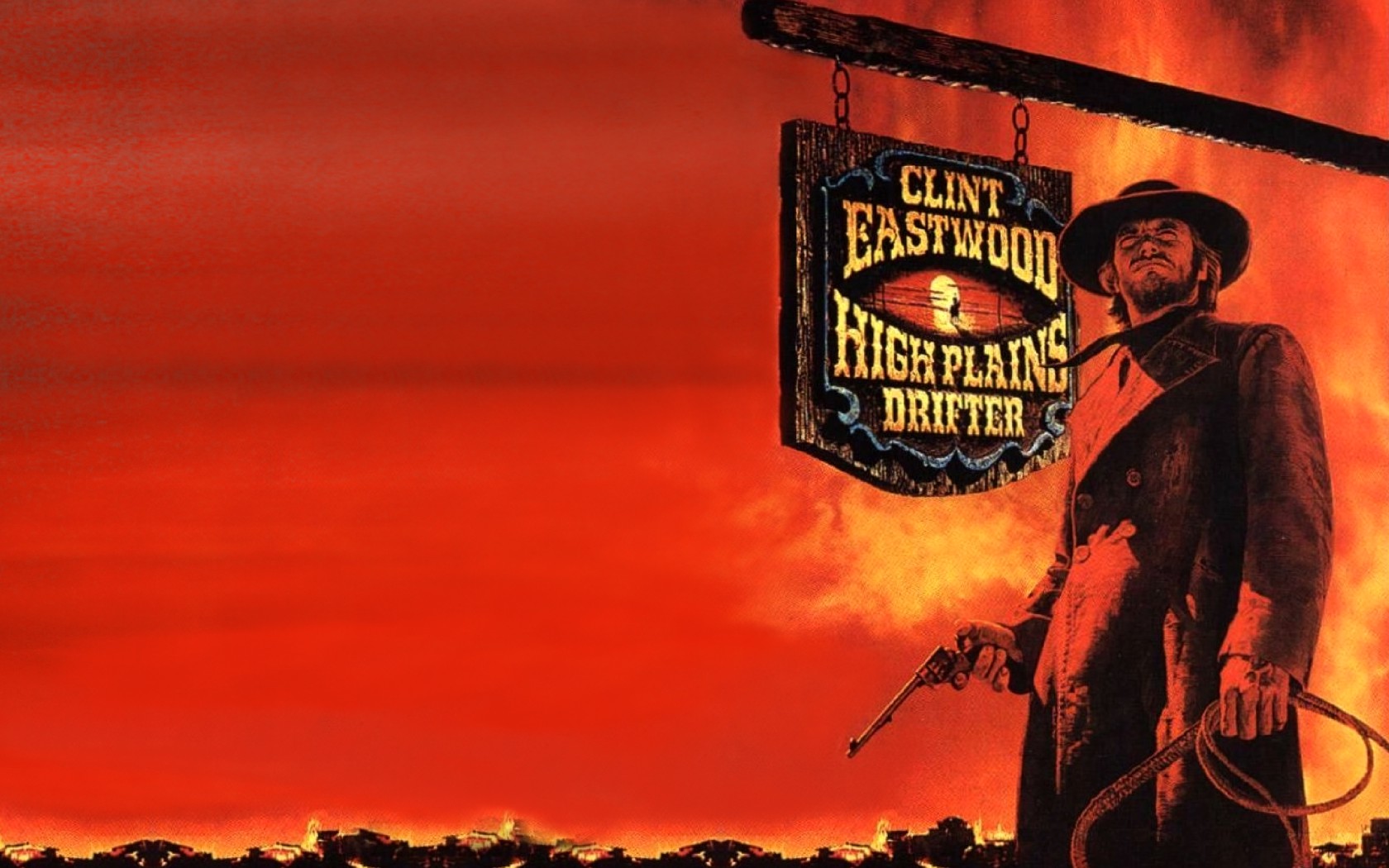
Showing posts with label Clint Eastwood. Show all posts

Friday, October 15, 2021

The Representation of Justice in HIGH PLAINS DRIFTER


"The Aesthetic Representation of Justice in Eastwood’s High Plains Drifter"

By Erin E. Flynn, Ph.D.

Ohio Wesleyan University


3. The Representation of Justice in High Plains Drifter

[footnotes have been omitted]

The order of justice in High Plains Drifter is distinctively retributive. It is a matter of answering for a crime, of getting precisely what is deserved. Consider, for example, the reversals and exposures that unfold once the Stranger is placed in charge. The greed that led to the town’s corruption is turned on its head. Economic exchange is reversed, as the Stranger appropriates and redistributes goods according to his whim. These reversals occur while the Stranger ironically attempts to teach the town the courage it needs to defend itself. Hence, in the process of teaching Lago the importance of courage, the Stranger exposes the corruption that flowed from the town’s lack of moral courage when it acquiesced to Duncan’s murder. That lesson is fully learned when Mordecai (Billy Curtis), the town “runt” who had cowered beneath a porch during Duncan’s murder, kills Belding as Belding aims to shoot the Stranger in the back. It is the final killing in the movie, marking Mordecai’s moral elevation and ensuring Sarah’s liberation. 

At the heart of these reversals is punishment for Duncan’s murder, and the punishment is startlingly precise. The wicked are killed; the weak are terrified. Those who bullwhipped the marshal are whipped in turn. The mayor (Stefan Gierasch) and the sheriff, who abdicated their duty to the law, are stripped of even the trappings of their false authority, replaced in their offices by Mordecai. Callie Travers, who used her sexuality to curry favor with powerful men, is raped. It would be no overstatement to say that, in the universe of High Plains Drifter, desert is the only engine that drives the narrative. 

The Stranger avenges Duncan’s murder, but he also forces Lago to acknowledge its guilt, which is essential to the retribution. This is clearest at the movie’s climax, when the townsfolk fearfully realize that the assassins are being killed by bullwhip at the site of the marshal’s murder. It is telling that nearly everything the people of Lago say about themselves and their town is false. Indeed, the movie’s first piece of dialogue seems designed to tell the viewer just this. The lead thug, or at least the most talkative one, tells the Stranger that most people find life in Lago a little too fast for them. But we have just seen the Stranger ride through a town that is motionless. What follows is a series of lies in which Lago attempts to hide its true identity. Of course, all of the lies flow from the town’s attempt to cover up its crime, a crime motivated by the need to keep the marshal from revealing the truth about the mining company’s claim, and so also about the founding and the legitimacy of the town itself. 

Sarah and Mordecai are the only townspeople who speak sincerely to the Stranger. Reflecting upon the threat the Stranger poses to the town, Sarah says: “You are a man that makes people afraid, and that makes you dangerous.” The Stranger replies: “It’s what people know about themselves inside that makes them afraid.” He is out to expose what they know inside and force them to acknowledge the truth about Lago. But everywhere in the civil order he would turn to discover the truth, he finds only lies. Instead, the truth about the whipping of the marshal is revealed in his dreams. The dream sequences recall the disorienting effect of the haze at the beginning of the movie. At first the viewer cannot discern what is going on, who is being whipped or why. But gradually the disorientation fades and the truth about Lago is revealed to us, even as the citizens of Lago try to obscure it, thereby revealing all the more about themselves. The Stranger need not bother with ordinary methods of discovery, and the viewer has access to what he knows via his dreams, which are perhaps revelations to him, but seem more likely to be tormenting reminders of something he already knows. And given the precision with which he metes out punishment, he seems to know it perfectly. The use of dreams makes the Stranger a kind of seer of hidden truths, and we are privy to his vision. They tell us, among other things, that knowing the relevant truth here, namely the guilt of the town, will not require investigation or argument. In short, no trial or deliberation will be necessary for justice to be done to Lago. 

The Stranger materializes out of the heat and descends from the mountains, killing and raping with ease. He paints Lago red, renames it “Hell,” and burns it clean in a ritualized acknowledgement of and atonement for its crime. He punishes all transgressors. He liberates Sarah and elevates Mordecai, the only two citizens who seem to have acknowledged and felt genuine remorse for Lago’s crime. Above all he avenges the murder of the marshal. When he leaves the town, though it has been decimated, the remaining inhabitants can breathe and even smile at last, their bloodguilt having been lifted, their civil order cleansed. He leaves Lago in the direction from which he came, through the cemetery. He was not passing through; Lago was his destination, his goal. Having done what he came to do, the Stranger returns into the haze of the hills, into whatever it is that stands behind nature, on the other side of the cemetery. 

As the Stranger leaves town, he passes Mordecai carving Duncan’s name into a grave marker. Duncan has been acknowledged, and this is a sign that the civil order has returned to legitimacy, each individual having received his due and recognition. Mordecai looks up at the Stranger and remarks that he still doesn’t know his name. The Stranger contradicts him. “Yes, you do,” he says. The final scene invites speculation about the identity of the Stranger. One possibility is that the Stranger’s name is Duncan, the dead marshal’s brother. Or perhaps the Stranger is the ghost of Duncan himself, who like the ghost of Banquo has returned to avenge his own murder. But the Stranger’s enigmatic claim that Mordecai knows his name also suggests that the name of the Stranger has been announced sometime before, or is eternally known. Death is his name. He rides a pale horse. Hell follows him. The first man he shoots, he shoots in the forehead, the crimson hole gaping as if to indicate that he did not have the seal of God on him. And though he kills the Bridges gang for their murder of Duncan, he also uses them as instruments of Lago’s destruction. Those three, Bridges and the Carlin brothers, are the other riders of this apocalypse. Hence the Stranger is an agent of God’s punishment. It is important that he remain nameless, though we are told that we know his name. This fact keeps him as close as possible to God the unnamable, to a strange and remote God. It keeps him from being one among the named inhabitants of the civil order. 

His strangeness and his precision are further keys to understanding the relation between the civil and the moral orders depicted in the movie. I spoke above of the moral law of some Westerns as transcendent in the sense of having authority independent of civil institutions. But here that transcendence appears to involve an authority beyond even nature itself. It is supernatural in contrast to the worldliness of the civil, and outstrips even the power of nature. It enjoys absolute authority over the civil order. It is supreme. When the civil order strays, its transgressions trigger retribution from beyond. This civil order of Lago cannot keep its own justice. To be righted and provided with at least the possibility of legitimacy, Lago needs an emissary, an executioner of the law beyond. High Plains Drifter represents that law as not only absolutely authoritative, but also as perfectly, metaphysically precise. The Stranger’s retribution is without error and in perfect keeping with the nature of Lago’s various crimes. He turns Lago inside out, cleanses it, while he and his law are utterly independent of it. The purity of his authority requires such transcendence. Far more radically than the gunfighter riding into the sunset, the Stranger rides out of materiality, out of corporeality, and into another world, into the domain of a perfectly just, and, for all we know merciless God.


Tuesday, May 22, 2018

ObamaGate - ItalyGate

Obama is demon possessed

Obama Should be Executed for TREASON

ItalyGate - Obama Orchestrated Election Steal in Italy

COMMENTARY:  ObamaGate will make Watergate look like a misdemeanor

By Wayne Allyn Root
Las Vegas Review-Journal
September 23, 2017

An ancient Chinese philosopher once said, “May you live in interesting times.” Congratulations, we’ve hit the jackpot.

We are in the beginning phase of Obamagate. This is our generation’s Watergate. Except far worse.

Here’s a refresher course for those too young to remember. Watergate was the biggest scandal in modern political history. Republican President Richard Nixon desperately wanted to know what Democrats were planning for their 1972 presidential campaign against him. He ordered a team of trusted aides to spy on them. They literally broke into the offices of the Democrat National Committee inside the Watergate Building. That was the beginning of the end for Nixon.

But today no one needs to physically break into an office to spy on a political rival. All you have to do is use the high-tech electronic power of government. A corrupt president can use the government to listen in on anyone, anytime.

The media and liberal critics went ballistic when Donald Trump tweeted in March that Barack Obama spied on him. CNN tweeted, “Trump’s baseless wiretap claim” and, “Trump just flat-out lied about wiretapping.” Well guess who was right? Trump — again.

According to multiple media reports out last week, officials in the Obama administration spied on the Trump campaign. They wiretapped Trump’s campaign manager Paul Manafort both before and after the election. It appears other top Trump aides were also wiretapped, as was Trump Tower.

If these media reports are proven true, then the Obama administration was spying on the entire Trump campaign staff. Even if they were listening in on only Manafort, to whom do you think he was speaking? Trump and every high-ranking member of Trump’s campaign staff.

Which means while government agents were supposedly listening for “criminal activity,” they just happened to hear every plan of the Trump campaign … they just happened to know what would be in Trump’s speeches … they knew his line of attack versus Hillary … they knew his debate prep … they knew everything Trump was planning before he did it. That’s some valuable inside information.

Obama just happened to pick the perfect guy to spy on — if he wanted to fix the election for Hillary.

It was the perfect crime — or so Obama thought. Because with all this inside information on the Trump campaign in the hands of Hillary and her campaign team, she couldn’t lose. And after her easy victory, Hillary would be in control of the Department of Justice. So who would ever investigate or prosecute?

Except Trump ruined everything by winning a “fixed” election against all odds. And now Trump controls the DOJ. Trump can investigate and prosecute. Obamagate is directly in Trump’s crosshairs.

Does this Obamagate gameplan sound familiar?

These are the same people who successfully “fixed” the primaries for Hillary. They cheated Bernie Sanders. They even gave CNN’s presidential debate questions to Hillary in advance. These are the same people who used the IRS to destroy Obama’s leading media critics and slow tea party fundraising and activism to a trickle during the 2012 Obama re-election run. Isn’t that an attempt to “fix” the election?

These are the same people caught spying on journalists of Fox News, The Associated Press and CBS’s Emmy Award-winning correspondent Sharyl Attkisson. These are the same people who unmasked Trump advisers and transition officials. Samantha Powers was unmasking names at a speed unheard of in political history.

This is Obamagate. It makes Watergate look like child’s play. The real question is: What did Obama himself know and when did he know it?

Fifty Cubits High
The Gates of Hell
Be Known By Hell
Barack Obama and Africa
Trump Won't Be Impeached, But Obama Will Be - Mark Taylor
Philandering FBI Agents Blow Obama's Cover on ObamaGate
The Biggest Political Scandal in Our History - Sebastian Gorka
Why Obama had to take out Flynn - Sebastian Gorka
ItalyGate:


_____

"The Watergate break-in was strictly based on one thing - the pedophile records that were being kept at the Democratic National Headquarters."

--Detective James Rothstein (NYPD, Retired)

[from Eyes Wide Open by Fiona Barnett, Chapter 1. "Watergate was Pedogate"]


_____


Monday, March 19, 2012

Freedom to Bear Arms


Here is an excellent video on The Battle of Athens, Tennessee in 1946.  I would like to thank Gorges Smythe for bringing this to my attention.

The Battle of Athens, Tennessee

_____

The Second Amendment to the U.S. Constitution:

"A well-regulated militia being necessary to the security of a free State, the right of the People to keep and bear arms shall not be infringed."

_____

"Remembering the words of Nehemiah the Prophet: 'The trowel in hand and the gun rather loose in the holster.'"

--T.S. Eliot

_____

"I have a very strict gun control policy:  if there's a gun around, I want to be in control of it."

--Clint Eastwood

_____

"This year will go down in history. For the first time, a civilized
nation has full gun registration. Our streets will be safer, our
police more efficient, and the world will follow our lead into the
future." 


--Adolf Hitler, 1935

Quotes from Thomas Jefferson
Constituting America
A Revolutionary People at War
You Could Hear a Pin Drop
Gun Control--or People Control?
Every one of the mass murderers was a Democrat
Black conservative leaders discus how the NRA was created to protect freed slaves
Molon Labe
Esther and the Second Amendment
A Dream about Donald Trump
Some Gun Control History
Perfect for a trench raid

Live Free or Die

_____

"In the end they will lay their freedom at our feet and say to us, Make us your slaves, but feed us."

--Fyodor Dostoyevsky

“A free people ought not only to be armed and disciplined, but they should have sufficient arms and ammunition to maintain a status of independence from any who might attempt to abuse them, which would include their own government.”

--George Washington

"There are two ways to conquer and enslave a nation.  One is by the sword.  The other is by debt."

--John Adams


Monday, August 2, 2010

Meeting a Former Editor from Warner Brothers

This story is a conversation between a hitchhiker and a former editor from Warner Brothers. The editor did some work on the film High Plains Drifter.

It was probably the spring of 1997. I hitchhiked north on U.S. 395 from southern California and got dropped off in Bishop. Bishop is a very beautiful place.

The mountains to the east were dry and brown, the mountains to the west (Sierra Nevadas) were rugged and snow-covered. There are a lot of irrigated ranches in that valley. I walked through Bishop for a couple of miles and then stopped north of town on U.S. 395. I waited for a short while and this vehicle pulled over to pick me up.

The guy who gave me a ride was probably in his late fifties or early sixties. He told me that he was coming from a ranch that he owned in Mexico; he was heading to Mammoth Lakes where he owned a grocery store. I told him that I was hitchhiking around the country for a short while; I had just quit my job at Harold Pike Construction Company in Ames, Iowa (Pike Construction hired me ten times in four years, I was grateful that they let me work for them so many times).

"So what did you do before you bought your ranch?" I asked.

"I worked for Warner Brothers as an editor," he replied. "I worked at Warner Bothers for a number of years and got tired of being in the studio."

"So what films did you work on?" I asked.

"One film I worked on was High Plains Drifter," he said.

I looked at him and exclaimed, "No way! High Plains Drifter? That is one of my favorite westerns. You are not going to believe this, but in 1995 I had a short story published by Ethos magazine. The title of my short story is 'High Plains Drifter.'"

"Really?"

"Yeah."

At the time, I had a few copies of my short story in a folder in my backpack. I would pass out my story to people if they were interested in reading it.

"When you drop me off, I will give you a copy of my short story," I said.

"Sounds good."

We drove north on U.S. 395. At Lake Crowley he turned off the road and dropped me off at this intersection. I dug out my folder that was in my backpack and gave him a copy of "High Plains Drifter."

"Thanks," he said.

"Thanks for the ride."

He drove off and I started walking up U.S. 395. I walked for a short while. The sun was down and I needed to find a place to sleep. I jumped over this fence and walked out into this sagebrush maybe a quarter of a mile from Lake Crowley. I rolled out my sleeping bag and slept there. I think it got down in the upper 20s F that night.

About my meeting the guy who gave me a ride from Bishop to Lake Crowley: there are no accidents in the Kingdom of Heaven. Things happen for a reason.

The next day I hitchhiked north to Reno.

[The film High Plains Drifter, starring Clint Eastwood, was made at Mono Lake near Lee Vining, California in 1973. Lee Vining is on U.S. 395 between June Lake and Bridgeport.]

[Originally published by Digihitch.com]

High Plains Drifter (short story) 

Friday, July 30, 2010

High Plains Drifter (short story)


High Plains Drifter
By Timothy Michael Shey

The big Kenworth roared west through Wyoming.

"So how long've ya been on the road?" the truck driver asked.

"A day or two," the young man replied.

"Where'd ya start out?"

"Western Nebraska. I was working on a ranch for a couple of days and got sick of it. I have a friend in California I want to see."

"California?"

"Yeah."

The truck driver was heavy-set and wore a short-cropped beard and baseball cap. The young man was slender and wore glasses. His only possessions: a backpack and sleeping bag.

"Ya got a long ways to go," the truck driver said. "I'll get ya to Salt Lake. Then I'm headin' north."

"Thanks for picking me up. It was cold standing out there."

"No problem."

The rugged, rolling terrain of Wyoming. The sagebrush. The dry air.

"So what'd ya do before the ranch?" the truck driver asked.

"I was in school in Manhattan."

"New York?"

"No. Kansas."

"Where ya from?"

"Garden City."

"I see."

The young man looked over the horizon to his right. There was silence for ten minutes except for the noise of the engine and the bounce of the tractor-trailer.

"So who's this friend of yours in California?" the truck driver asked.

"She's a poet."

"She?" The truck driver smiled and looked at the young man.

"I've never met her before. I've read a couple of her books and we've exchanged a few letters, that's all."

"I see."

"She has a daughter going to school in Santa Cruz that I thought I might like to visit, also."

"I don't know much about poetry. Is it like drivin' a truck?" the truck driver asked jokingly.

"Exactly." Exactly. Poetry is breath and fire and pain. Poetry is getting drunk or stacking hay on a ranch in western Nebraska. It is holding a beautiful woman in your arms; it is holding a baby in your lap. It is dropping out of high school because of the shallowness and stupidity. Exactly. Poetry is hitchhiking all the way to California to see a brilliant woman who loves the letters you write.

"So where'd ya stay last night? It got pretty cold out there."

"A rancher picked me up outside of Laramie. He drove me to Rock Springs where his parents live. They let me stay overnight. Wonderful people. Gave me supper and breakfast."

"No kiddin'?"

"It was pretty incredible."

"I'll say. All a person hears about are people gettin' robbed or killed on the road."

"Yeah. Really."

The big Kenworth was going 80 miles per hour, passing cars and trucks. The speed and the power, the stress of steel and bolt, piston and axle and 18 wheels. Going west. Going west.

"So where you going after Salt Lake City?" the young man asked.

"Headin' north of Pocatello. Then I'll head back to Denver with another load."

Fire and breath and pain and heading north to Pocatello. Pocatello of your dreams. Pocatello of your nightmares. Six men die in gun battle with federal marshals at the Pocatello Corral. Southern Idaho desert. Dry heat, dry grass, dry blood on dry earth. Exactly. The breath of the moment, the heat of the battle--firefight in the Pocatello Corral. One federal marshal wounded. Dry sun on another horizon. This is not Kansas. This is not Nebraska. This is Pocatello. Pocatello of your nightmares.

"This sure is wide open country," the young man said.

"It's a wasteland. Desert."

"I like wide open spaces."

"Then ya won't like California. Ever been to L.A. or Frisco?" the truck driver asked.

"No."

"Where does your poet friend live?"

"Big Sur."

"Never been there."

California of your nightmares. Big Sur of your dreams. Fire out of Kansas. Wheatfields and golden landscapes and dry air and blue sky and. Words, ink on paper, meter and fire. The anvil and the hammer and the fireblood of a wounded heart. Laceration and pain. Fire. The wordsmith labors and sweats and bleeds and brings forth new life. Anvil and hammer. The hot steel is shaped. Blow after blow. Sparks fly in the hot and dry air of Kansas.

"So how old are ya?" the truck driver asked.

"Twenty-three."

"So what do ya want to do with your life?"

"I want to be a bounty hunter or President of the United States."

The truck driver smiled and chuckled. "Sounds good to me. Ever see High Plains Drifter with Clint Eastwood?"

"I am the High Plains Drifter."

Flame out of Kansas. Riding west to the gold rush of your dreams. Desperate, unshaven, sunburned and hungry. Big Sur on your mind. Leather boots, leather skin, the stink of horse sweat. Shot six men in Pocatello just to watch them die. The bullet wounds of your heart, the anguish of the moment. Six men in Pocatello. Just to watch them die. You cinch the saddle down tight and ride west with the hot wind of Idaho at your back. You will ride west where the Pacific meets the edge of the Universe. There you will grow new muscle and ride a horse of a different color.

West. Flame out of Kansas. Exactly.

The big Kenworth rolled west through Wyoming and eternity.

Ethos
May 1995
Iowa State University

[Republished by Digihitch.com]

Book Review:  High Plains Drifter


Tuesday, July 20, 2010

Two Dreams: General George Patton and Clint Eastwood


Dreams from the LORD 2003-2006
6 February 2006

Last night I had two dreams. In the first dream, there were all of these soldiers (U.S. Army) in parade dress standing at attention on a football field. Then General George S. Patton walked onto the football field with a few other soldiers; he was wearing a helmet and dress uniform. He became very angry and pulled out his sidearm and began shooting and killing the soldiers on the football field. The soldiers broke ranks and began to flee in all directions. General Patton continued to shoot and kill the soldiers as they tried to run away from him.

In the second dream, I saw General George Patton and Clint Eastwood and they were dressed in combat fatigues. They were wearing winter coats. They were not wearing helmets. Their faces were smudged and dirty. They were smiling at each other and laughing. It looked like they had just gotten back from a successful combat mission.

A Dream About General George S. Patton
Another Dream with General George S. Patton
Clint Eastwood's film High Plains Drifter (1973)
Prophetic Photographs:  Patton and Trump


Friday, March 26, 2010

Clint Eastwood's film HIGH PLAINS DRIFTER (1973)


The first time I saw High Plains Drifter was probably in the late 1970s. Clint Eastwood stars in and directs the film. Most westerns are either about cattle drives or cowboys and Indians. High Plains Drifter is different: this is a God's-Judgment-on-the-wicked western.

Clint Eastwood plays a stranger who rides into the town of Lago--and he has a really bad attitude. This stranger is also very good with a side arm. During the course of the film, the stranger ends up killing some bad guys and burning the town of Lago to the ground. There are a couple of flashbacks of one Marshal Jim Duncan being whipped to death.  At the end of the film, the audience can see that the stranger was the Second Coming of Marshal Duncan:

The stranger rides out of the town of Lago past the cemetery. This little guy named Mordecai is writing something on a grave marker. 

The stranger looks at Mordecai and Mordecai looks up and says, "I'm almost done here."


Then Mordecai asks the stranger, "I never did know your name."

And the stranger replies, "Yes, you do."

As the stranger rides off, the camera shows the grave marker: "Marshal Jim Duncan."

There is a lot of sin (unrepented sin) in the United States and in the world. When people continue to live in sin, eventually God's Judgment falls. The more people try to hide their sin, the greater God's Judgment. The people of Lago tried to hide the murder of Marshal Duncan, but their sin was found out. You can't hide from God.

There is a scene in High Plains Drifter where this lady tells the stranger, "Ever since Marshal Duncan's death, the people in this town are afraid of strangers."
_____

"When the Stranger says: 'What is the meaning of this city?
Do you huddle close together because you love each other?'
What will you answer? 'We all dwell together
To make money from each other'? or 'This is a community'?

"Oh my soul, be prepared for the coming of the Stranger.
Be prepared for him who knows how to ask questions.

"There is one who remembers the way to your door:
Life you may evade, but Death you shall not.
You shall not deny the Stranger."

--T.S. Eliot
Choruses from "The Rock"

_____

There is another scene in High Plains Drifter where the people of Lago are meeting at the church. One of the guys is speaking in the front of the church. The camera then pans to the right and shows a bulletin board with this Scripture:

Isaiah 53: 3-4: "He is despised and rejected of men; a man of sorrows, and acquainted with grief: and we hid as it were our faces from him; he was despised, and we esteemed him not.  Surely he hath borne our griefs, and carried our sorrows: yet we did esteem him stricken, smitten of God, and afflicted."


The Days of Vengeance

Marshal Jim Duncan was whipped to death; Jesus Christ was at least nine-tenths whipped to death. The stranger riding into Lago (the first scene of the film) is a symbol of the Second Coming of Jesus Christ: not as the Lamb of God, but as the Lion of the Tribe of Judah.

Isaiah 63: 1-6: "Who is this that cometh from Edom, with dyed garments from Bozrah? this that is glorious in his apparel, travelling in the greatness of his strength? I that speak in righteousness, mighty to save. Wherefore art thou red in thine apparel, and thy garments like him that treadeth in the winefat? I have trodden the winepress alone; and of the people there was none with me: for I will tread them in mine anger, and trample them in my fury; and their blood shall be sprinkled upon my garments, and I will stain all my raiment. For the day of vengeance is in mine heart, and the year of my redeemed is come. And I looked, and there was none to help; and I wondered that there was none to uphold: therefore mine own arm brought salvation unto me; and my fury, it upheld me. And I will tread down the people in mine anger, and make them drunk in my fury, and I will bring down their strength to the earth."

Luke 21: 22:  "For these be the days of vengeance, that all things which are written may be fulfilled."

I Thessalonians 5:2:  "For yourselves know perfectly that the day of the Lord so cometh as a thief in the night."


The Killer Angels
The Second Coming