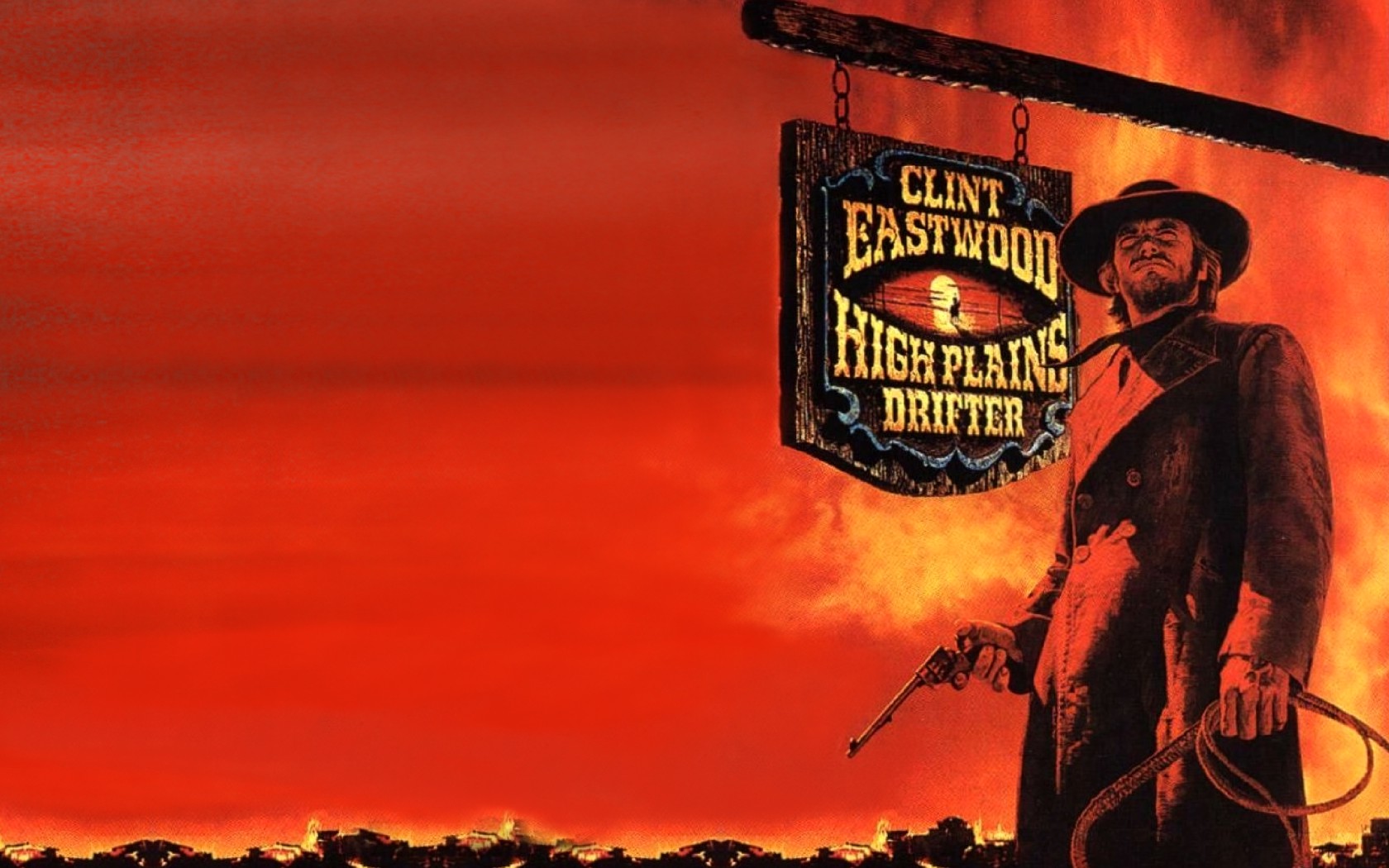
"The Aesthetic Representation of Justice in Eastwood’s High Plains Drifter"
By Erin E. Flynn, Ph.D.
Ohio Wesleyan University
3. The Representation of Justice in High Plains Drifter
[footnotes have been omitted]
The order of justice in High Plains Drifter is distinctively retributive. It is a matter of answering for a crime, of getting precisely what is deserved. Consider, for example, the reversals and exposures that unfold once the Stranger is placed in charge. The greed that led to the town’s corruption is turned on its head. Economic exchange is reversed, as the Stranger appropriates and redistributes goods according to his whim. These reversals occur while the Stranger ironically attempts to teach the town the courage it needs to defend itself. Hence, in the process of teaching Lago the importance of courage, the Stranger exposes the corruption that flowed from the town’s lack of moral courage when it acquiesced to Duncan’s murder. That lesson is fully learned when Mordecai (Billy Curtis), the town “runt” who had cowered beneath a porch during Duncan’s murder, kills Belding as Belding aims to shoot the Stranger in the back. It is the final killing in the movie, marking Mordecai’s moral elevation and ensuring Sarah’s liberation.
At the heart of these reversals is punishment for Duncan’s murder, and the punishment is startlingly precise. The wicked are killed; the weak are terrified. Those who bullwhipped the marshal are whipped in turn. The mayor (Stefan Gierasch) and the sheriff, who abdicated their duty to the law, are stripped of even the trappings of their false authority, replaced in their offices by Mordecai. Callie Travers, who used her sexuality to curry favor with powerful men, is raped. It would be no overstatement to say that, in the universe of High Plains Drifter, desert is the only engine that drives the narrative.
The Stranger avenges Duncan’s murder, but he also forces Lago to acknowledge its guilt, which is essential to the retribution. This is clearest at the movie’s climax, when the townsfolk fearfully realize that the assassins are being killed by bullwhip at the site of the marshal’s murder. It is telling that nearly everything the people of Lago say about themselves and their town is false. Indeed, the movie’s first piece of dialogue seems designed to tell the viewer just this. The lead thug, or at least the most talkative one, tells the Stranger that most people find life in Lago a little too fast for them. But we have just seen the Stranger ride through a town that is motionless. What follows is a series of lies in which Lago attempts to hide its true identity. Of course, all of the lies flow from the town’s attempt to cover up its crime, a crime motivated by the need to keep the marshal from revealing the truth about the mining company’s claim, and so also about the founding and the legitimacy of the town itself.
Sarah and Mordecai are the only townspeople who speak sincerely to the Stranger. Reflecting upon the threat the Stranger poses to the town, Sarah says: “You are a man that makes people afraid, and that makes you dangerous.” The Stranger replies: “It’s what people know about themselves inside that makes them afraid.” He is out to expose what they know inside and force them to acknowledge the truth about Lago. But everywhere in the civil order he would turn to discover the truth, he finds only lies. Instead, the truth about the whipping of the marshal is revealed in his dreams. The dream sequences recall the disorienting effect of the haze at the beginning of the movie. At first the viewer cannot discern what is going on, who is being whipped or why. But gradually the disorientation fades and the truth about Lago is revealed to us, even as the citizens of Lago try to obscure it, thereby revealing all the more about themselves. The Stranger need not bother with ordinary methods of discovery, and the viewer has access to what he knows via his dreams, which are perhaps revelations to him, but seem more likely to be tormenting reminders of something he already knows. And given the precision with which he metes out punishment, he seems to know it perfectly. The use of dreams makes the Stranger a kind of seer of hidden truths, and we are privy to his vision. They tell us, among other things, that knowing the relevant truth here, namely the guilt of the town, will not require investigation or argument. In short, no trial or deliberation will be necessary for justice to be done to Lago.
The Stranger materializes out of the heat and descends from the mountains, killing and raping with ease. He paints Lago red, renames it “Hell,” and burns it clean in a ritualized acknowledgement of and atonement for its crime. He punishes all transgressors. He liberates Sarah and elevates Mordecai, the only two citizens who seem to have acknowledged and felt genuine remorse for Lago’s crime. Above all he avenges the murder of the marshal. When he leaves the town, though it has been decimated, the remaining inhabitants can breathe and even smile at last, their bloodguilt having been lifted, their civil order cleansed. He leaves Lago in the direction from which he came, through the cemetery. He was not passing through; Lago was his destination, his goal. Having done what he came to do, the Stranger returns into the haze of the hills, into whatever it is that stands behind nature, on the other side of the cemetery.
As the Stranger leaves town, he passes Mordecai carving Duncan’s name into a grave marker. Duncan has been acknowledged, and this is a sign that the civil order has returned to legitimacy, each individual having received his due and recognition. Mordecai looks up at the Stranger and remarks that he still doesn’t know his name. The Stranger contradicts him. “Yes, you do,” he says. The final scene invites speculation about the identity of the Stranger. One possibility is that the Stranger’s name is Duncan, the dead marshal’s brother. Or perhaps the Stranger is the ghost of Duncan himself, who like the ghost of Banquo has returned to avenge his own murder. But the Stranger’s enigmatic claim that Mordecai knows his name also suggests that the name of the Stranger has been announced sometime before, or is eternally known. Death is his name. He rides a pale horse. Hell follows him. The first man he shoots, he shoots in the forehead, the crimson hole gaping as if to indicate that he did not have the seal of God on him. And though he kills the Bridges gang for their murder of Duncan, he also uses them as instruments of Lago’s destruction. Those three, Bridges and the Carlin brothers, are the other riders of this apocalypse. Hence the Stranger is an agent of God’s punishment. It is important that he remain nameless, though we are told that we know his name. This fact keeps him as close as possible to God the unnamable, to a strange and remote God. It keeps him from being one among the named inhabitants of the civil order.
His strangeness and his precision are further keys to understanding the relation between the civil and the moral orders depicted in the movie. I spoke above of the moral law of some Westerns as transcendent in the sense of having authority independent of civil institutions. But here that transcendence appears to involve an authority beyond even nature itself. It is supernatural in contrast to the worldliness of the civil, and outstrips even the power of nature. It enjoys absolute authority over the civil order. It is supreme. When the civil order strays, its transgressions trigger retribution from beyond. This civil order of Lago cannot keep its own justice. To be righted and provided with at least the possibility of legitimacy, Lago needs an emissary, an executioner of the law beyond. High Plains Drifter represents that law as not only absolutely authoritative, but also as perfectly, metaphysically precise. The Stranger’s retribution is without error and in perfect keeping with the nature of Lago’s various crimes. He turns Lago inside out, cleanses it, while he and his law are utterly independent of it. The purity of his authority requires such transcendence. Far more radically than the gunfighter riding into the sunset, the Stranger rides out of materiality, out of corporeality, and into another world, into the domain of a perfectly just, and, for all we know merciless God.